
Loudoun City Directory Collections
Published local-directory years for Loudoun County and Leesburg were not located in the official catalog material reviewed. That limit matters. A city directory search should begin with the Thomas Balch Library research service and its Centennial Catalog, not with a promised publisher or run that has not been verified. Thomas Balch is a public, non-circulating local-history and genealogy library. Visitors may browse collections without a card, while archival material is retrieved by staff and used at designated desks.
| Collection | Years | Where Held | Access |
|---|---|---|---|
| Local city and reverse-directory volumes | Year run not located in the official catalog | Centennial Catalog and Thomas Balch reference desk | Ask for a targeted catalog or collection check |
| Deed and will microfilm | Most years through 1904 | Thomas Balch Library | Onsite microfilm and published indexes |
| Federal census microfilm | Loudoun 1810-1930 | Thomas Balch Library | Onsite microfilm and onsite databases |
| Tax-roll microfilm | 1758-1870, by roll type | Thomas Balch Library | Onsite, with a published personal-property index |
| 1815 Virginia landowners directory and gazetteer | 1815 | FamilySearch catalog | Cataloged landowner resource, not a reverse directory |
The table separates verified collections from the unverified city-directory shelf. Thomas Balch holds maps, family files, vertical files, newspapers, historic-house files, census, tax rolls, and court-related material that can bridge a missing directory year. A public environmental assessment mentions city, cross-reference, and telephone directories reviewed from 1970 through 2018 for one Loudoun property, but it is not evidence of a complete library run. Note: Record the volume title and year from the catalog or shelf before relying on it as Loudoun coverage.
Thomas Balch and Loudoun Directories
The Centennial Catalog offers several better starting points when a direct city directory cannot yet be confirmed. Family Files, Maps, Topical Files, Unpublished Papers, and Vertical Files are all name or address paths. The library also holds many local newspapers on microfilm. Older and more recent papers that are not on microfilm are cataloged as archive items with box numbers, then requested through the Collection Request process. The reference service can receive a remote question, though extensive research is not promised and paid one-hour research is available.
A useful request names the person, community, approximate period, variant spellings, street or legal description, and the catalog term already tried. Search terms supported by the research include “Loudoun directory,” “Leesburg directory,” “Virginia business directory,” “cross-reference directory,” “reverse directory,” “telephone directory,” “gazetteer,” and “house history.” A catalog miss does not establish that no archival material exists. It can mean that the relevant material is described through a collection guide, a box number, or another index.
The Loudoun County Historical Society Records finding aid shows one documented archive route at Thomas Balch. The Society collection covers 1954-2012 and includes minutes, correspondence, manuscripts, newspaper-clipping copies, photographs, and audiovisual materials. Those records are not city directories, but they can provide the local setting needed to test a name, institution, or place found elsewhere.
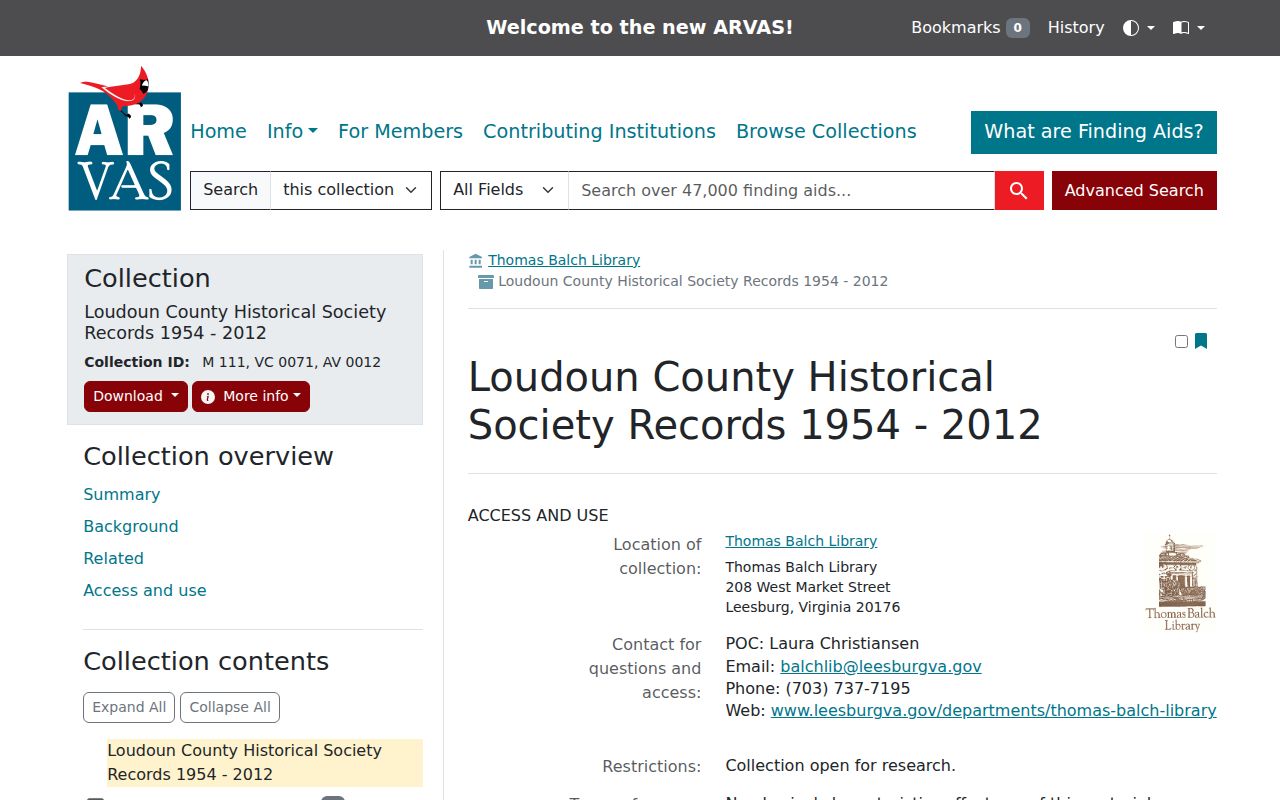
The finding aid is especially useful when a directory-style search turns into a question about a neighborhood organization, school, family paper, or local event. Reproduction permission and collection access terms still apply.
Verify Loudoun City Directory Years
Do not infer a city-directory publisher, a reverse-directory period, or a complete local shelf from a neighboring Virginia collection. The official research located no exact Loudoun County or Leesburg publisher list, year span, or inspected local entry. The appropriate sequence is to search the Centennial Catalog, ask the reference desk for the specific year and town, and then confirm whether the item is a person directory, a telephone book, a business directory, a landowner gazetteer, or an address index. Each type answers a different question.
The 1815 Directory of Virginia Landowners and Gazetteer, abstracted by Roger G. Ward, includes Loudoun County. It is a landowner and place resource, not a replacement for a local person volume or a reverse directory. For earlier geographic context, the 1854 Yardley Taylor map names landowners and includes town insets for Leesburg, Middleburg, and Waterford. The 1886 Leesburg Sanborn map depicts buildings, uses, and street form, but it does not list every occupant.
Those distinctions protect against a common error: a map can place an owner, a deed can convey a tract, and a census can show a household, yet none alone creates a directory listing. Pair the record type with the question. A historic volume can be useful evidence of a listing at a stated time, but the exact local volume must be seen before its fields or coverage are described as Loudoun facts.
Reading a Loudoun City Directory Entry
No official Loudoun directory entry was inspected during the research. The inventory below is therefore a field checklist for a volume found through the catalog or reference desk, not a statement that every Loudoun volume contains these fields. Photograph or transcribe the title page, publication year, town coverage, page number, and abbreviation key before interpreting a person line. That context makes a later comparison possible.
| Field to check | Copy the head-of-household or business name exactly, including initials and spelling variants. |
|---|---|
| Relationship notation | Check for a spouse in parentheses, widow wording, boarder or lodger notation if the volume uses it. |
| Work notation | Capture an occupation or business only if printed in the inspected entry. |
| Address form | Record house number, street, suffix, town label, and whether an alphabetical or address section was used. |
| Occupancy mark | Check the volume key before interpreting any owner, renter, residence, or boarding abbreviation. |
- Criss-cross directory
- An address-order section that may group listings by street rather than by surname, if the particular volume includes one.
- Householder index
- An index organized around the named household contact; it may omit other people at the address.
- Abbreviation key
- The publisher’s explanation of shortened terms and marks. Read it before treating a symbol as evidence of ownership or residence.
A name can appear under a spouse, a widow designation, initials, a business, or a boarder rather than the person expected. Exact transcription matters more than a quick normalized search. It also keeps a later deed, census, tax, or newspaper check tied to the wording actually seen.
Loudoun Directories With Census Years
When a volume is located, follow one household in a measured sequence rather than treating it as an isolated find. Start with the town or county status, the old and current street form, parcel or PIN, lot and block, or legal description. Search the surname alphabetically first, then use an address-order section only if that volume has one. Preserve every spelling and abbreviation. A person can appear under a spouse, business name, initials, or occupancy role, especially when the same surname occurs in several Loudoun communities.
- Identify the locality and date of the target address, retaining both old and current street names when available.
- Locate a directory volume close to the relevant deed or census year, then capture the title and page before extracting the line.
- Compare surname forms and address wording with the closest federal census, using the library’s Loudoun microfilm for 1810-1930.
- Use tax rolls to test whether the place concerns a landowner, a nearby farm, or a similarly named tract.
- Check newspaper, cemetery, obituary, deed, and historic-house evidence for a move, death, or address change.
Federal census years can anchor the process, but the 1890 census was largely lost. Loudoun tax rolls and deeds are especially helpful across that gap. A census household and a directory listing each describe one point in time, so neither proves every person remained at the address throughout the interval.
Loudoun Historic Records Timeline
Loudoun’s wider record chronology helps place a found directory beside the right companion source. The county was formed from western Fairfax County in 1757, and the first court met on July 12 of that year. The Clerk reports that county court records have survived without destruction by fire, war, or environmental causes. That continuity makes the courthouse and Thomas Balch practical fallbacks when a directory year cannot be located.
| 1757 | Loudoun County begins its court-record tradition; historic Clerk records reach back to county formation. |
|---|---|
| 1758-1870 | Thomas Balch tax-roll microfilm provides tithables, personal-property, and land-tax evidence by record type. |
| 1810-1930 | Thomas Balch holds Loudoun federal census microfilm; 1890 remains the major federal gap. |
| 1757-1903 | Historic deed PDFs are available through the Clerk’s indexed blocks, with deed-book and plat paths extending further. |
| 1954-2012 | The Loudoun County Historical Society Records offer an archival setting for later community research. |
The Clerk’s historic index page covers multiple record families, including deeds, marriages, wills, guardians, chancery, military material, and road cases. The result is an evidence chain, not a single master list. A directory line gains strength when its name, place, and time align with an independent local record.
Newspapers Extend Loudoun Directory Trails
Thomas Balch’s newspaper route can clarify a departure that a directory alone cannot explain. Many newspapers are on microfilm, while non-microfilm material may be an archive item with a box number. The Loudoun County Newspaper Index has posted surname blocks A-I, J-R, and U-Z, with updates dated 2013, 2015, and 2018. Check the S-T status rather than assuming the name index is complete. A newspaper notice can suggest a death, organization, property event, or move, but should be matched to the correct person.
The library’s online cemetery index covers more than 200 local cemeteries, and tombstone photographs are available onsite. Cemetery evidence is a useful endpoint for a former resident, not proof of a current address. Family Files, church and cemetery microfilm, Quaker resources, and ethnic-history collections can also help with the county’s varied settlement history. Communities such as Waterford, Lovettsville, Ashburn, Sterling, Leesburg, Hamilton, and Purcellville may appear in records before a modern ZIP label.
For a modern street-by-street parcel trail, use the address-focused Loudoun County street directory. Historical volumes work best as one layer among the catalog, census, tax, courthouse, newspaper, and cemetery routes described here.